
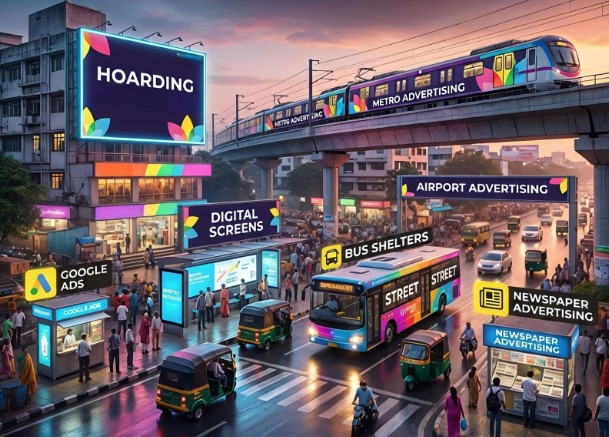
New Delhi [India], February 20: With location-based media poised for steady growth, regional leaders in Pune are aligning infrastructure expansion with structured outdoor networks
India’s advertising industry is projected to cross the ₹2 lakh crore mark in 2026, according to forecasts by global media investment firm WPP. The milestone reflects not just scale but structural transformation, with digital formats expected to command nearly two-thirds of total ad expenditure.
Yet even as digital dominates media allocations, location-based media — including out-of-home (OOH) advertising — is demonstrating structural resilience. Industry projections indicate high single-digit growth for location-based formats, supported by infrastructure expansion, rising mobility, and renewed advertiser confidence in physical visibility.
For organised regional OOH players, particularly in Maharashtra’s high-growth corridors, the next phase of expansion is being defined less by inventory volume and more by compliance, structural durability, and geographic concentration.
Infrastructure-Led Visibility
The Mumbai-Pune economic belt continues to evolve into one of western India’s most dynamic industrial and residential clusters. Highway upgrades, logistics hubs, toll corridors, and peri-urban real estate expansion have broadened the canvas for outdoor advertising.
In such corridors, premium-format hoardings are increasingly viewed as long-term brand assets aligned with sustained commuter traffic rather than short-term promotional placements.
Advertisers across categories — including cement, automotive, pharmaceuticals, electronics retail and e-commerce — continue to rely on outdoor media to reinforce brand salience. Companies such as UltraTech Cement, Skoda Auto Volkswagen India, Mankind Pharma, HP World, D Mart and Amazon India maintain active outdoor visibility across key Indian markets, underscoring continued advertiser trust in the medium.
Compliance as Competitive Advantage
Regulatory tightening around hoardings in Maharashtra has accelerated formalisation within the OOH ecosystem. Authorities have emphasised structural audits, licensing clarity, and standardised permissions — developments that industry participants say are strengthening long-term credibility.
While compliance requirements may lengthen execution timelines, organised operators argue that structured approvals and engineering-backed installations ultimately enhance advertiser confidence.
“Outdoor advertising is entering a more disciplined era,” said Shubham Jain, an outdoor media entrepreneur based in Pune. “As India’s advertising market scales toward ₹2 lakh crore, brands are prioritising partners who offer compliant, structurally sound, and strategically located media assets. The future belongs to organised OOH.”
Market Leadership in Pune
Within this evolving landscape, Pune has emerged as a strategic outdoor advertising hub. The city’s expanding industrial footprint, IT corridors, and residential growth belts have transformed it into a high-impact media market in western India.
Shubindia Ad Works has built a concentrated portfolio of premium-format hoardings across key arterial routes, toll corridors and infrastructure-led growth zones around Pune. Industry observers describe this cluster-based approach as creating a strategically dominant footprint in the Pune outdoor advertising market.
As advertisers seek consistent visibility across major commuter routes, consolidation has favoured organised players with on-ground execution capabilities and regulatory familiarity. In Pune, structured inventory ownership and corridor concentration are increasingly differentiating factors.
“Pune is no longer just a regional city — it is a strategic growth engine for western India,” Jain added. “Brands entering or expanding in the region prioritise high-impact outdoor visibility here, and organised inventory networks make that possible at scale.”
Growth Amid Digital Dominance
Digital advertising continues to attract the largest share of marketing budgets, driven by targeting capabilities and measurable performance. However, OOH retains distinct advantages — geographic precision, unavoidable exposure, and repeated high-frequency visibility in real-world environments.
Unlike digital formats that can be skipped or blocked, outdoor media commands attention within physical space. For infrastructure, retail and mass-market categories, physical scale remains integral to brand recall.
Industry analysts note that while digital will remain the fastest-growing segment, steady OOH expansion reflects structural relevance rather than cyclical recovery. The gradual integration of digital screens and data-backed measurement tools is further modernising traditional outdoor formats.
The Road Ahead
As India’s advertising industry approaches the ₹2 lakh crore milestone projected by WPP, the interplay between digital scale and physical visibility will shape media strategy decisions.
For organised OOH operators, the opportunity lies in disciplined expansion — aligning infrastructure corridors, regulatory clarity and concentrated geographic dominance.
In markets like Pune, where industrial growth and urban mobility converge, structured outdoor networks are increasingly viewed as gateway assets for western India brand rollouts.
“The transformation of outdoor media is not about competing with digital,” Jain said. “It is about complementing it — offering scale, permanence and trust in a rapidly expanding advertising economy.”
In an increasingly screen-saturated environment, compliant, strategically positioned billboards continue to deliver something uniquely powerful: sustained, unavoidable presence in the physical world.
This article includes sponsored content. The views expressed are those of the sponsor and do not necessarily reflect the official policy or position of our publication.